
Marketing
Technology
3D printing in event marketing: Why temporary installations still need to be high-quality
Large-format 3D printing for event marketing: High-quality temporary installations, photo spots, and brand objects.
Why high-quality event installations are so important
Event marketing is all about the moment. A product launch, trade fair, pop-up store, roadshow, or brand activation often lasts only a few days, sometimes even just a few hours. Yet, everything must work perfectly in that short window: the concept, the staging, the brand impact, and the attention it generates.
This is precisely why temporary installations are more demanding than they might appear at first glance.
An object used only briefly must not look generic. It sits at the center of attention, is photographed, filmed, shared, and immediately associated with the brand. If an event installation looks cheap, unstable, or unfinished, it reflects poorly not just on the object, but on the entire campaign.
Large-format 3D printing offers unique advantages in event marketing. It enables custom shapes, short lead times, eye-catching sizes, and brand-appropriate finishes. Digital campaign ideas can be transformed into physical objects that attract visitors, define spaces, and bring content to life.
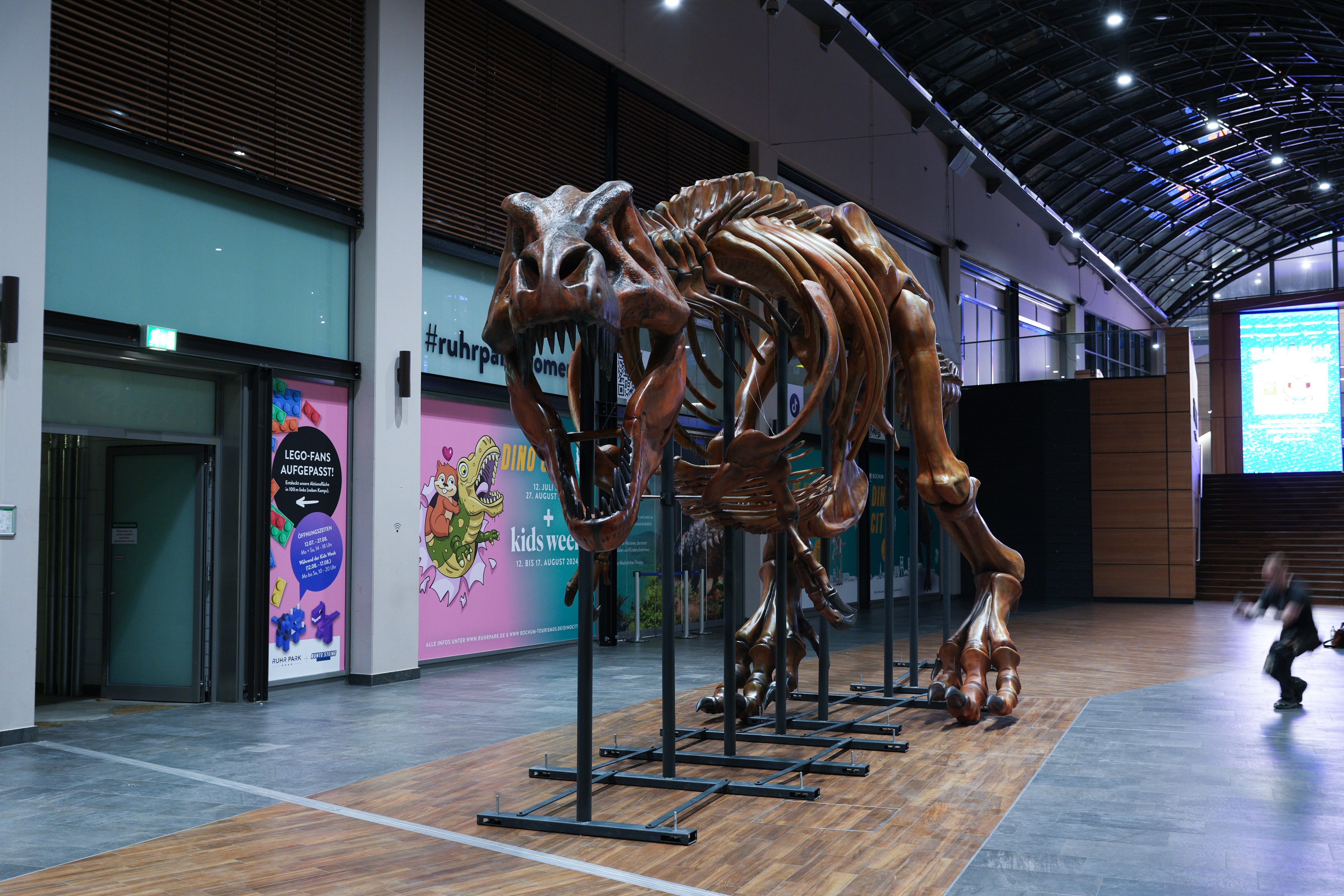
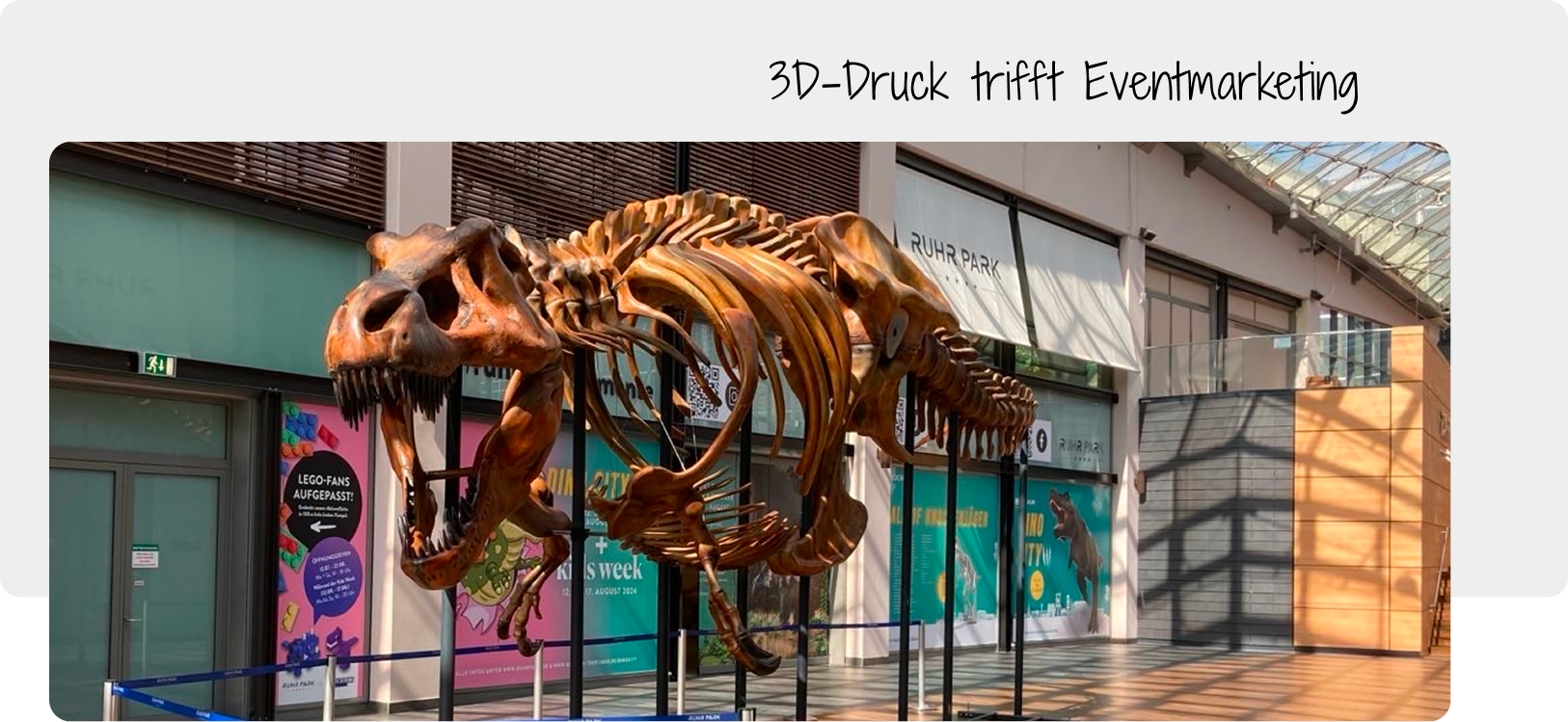
The impressive impact such a temporary installation can have was demonstrated in 2024 by one of our most spectacular projects to date: a life-sized, 3D-printed T-Rex skeleton that was on display for several weeks at what was then the Ruhr Park Bochum, now Westfield Ruhr Park.
The crucial question, therefore, is not: Is quality worth it if an object is only used temporarily?
But rather: Precisely because its use is limited in time, its impact must be immediately convincing.
In short: Why high-quality event installations are so important
Temporary installations must be high-quality because they need to generate maximum impact in a short amount of time. They serve as eye-catchers, photo spots, brand objects, landmarks, or central elements of a campaign.
Large-format 3D printing is particularly well-suited for this because:
- custom shapes can be realized quickly,
- digital campaign motifs become physically tangible,
- product enlargements and brand figures generate attention,
- objects work well for photos, videos, and social media,
- size, weight, segmentation, and transport are easily planned,
- surfaces look premium through sanding, filling, and painting,
- temporary objects can be precisely tailored to the brand, space, and occasion.
A temporary object is therefore no less important just because it isn't permanent. On the contrary: it must have an especially strong impact within a very short timeframe.
Why event marketing needs physical experiences
Many campaigns begin digitally. They appear on websites, social media, in ads, on displays, or in presentations. But events work differently. It’s not just about what is seen, but what is experienced.
A physical object in a space creates a different impact than an image on a screen. It has size, presence, texture, and context. Visitors can walk around it, stand in front of it, take photos with it, or use it as a landmark.
That is exactly why event installations are so valuable.
They create:
- Attention in the space,
- Emotional connection to the brand,
- Talking points,
- Photo opportunities,
- Brand recognition,
- Social media content,
- Orientation within a venue,
- A tangible center for the campaign.
A good event object is more than just decoration. It translates a campaign idea into a spatial experience.
Large-format 3D printing makes exactly that possible: it transforms digital ideas, products, characters, or key visuals into physical objects that visitors can experience firsthand.
Temporary doesn't mean secondary
A common misconception in event marketing is that if something is only used for a short time, it doesn't need to be high quality.
The opposite is true.
With temporary installations, the first impression is crucial. There is no long adjustment period. No object that is slowly noticed over months. No quiet piece of furniture in the background. An event installation has to work immediately.
It must stand out at first glance.
It must look great in photos.
It must align with the brand.
It must be structurally sound.
It must be crafted to a high standard.
It must not look unfinished under lights, on camera, or up close to an audience.
At events, quality is scrutinized intensely. Visitors, customers, partners, the press, and social media users often see the object in a single moment that is then documented and shared.
That is why a high-quality appearance is not an extravagance, but a necessity.
Our services
01
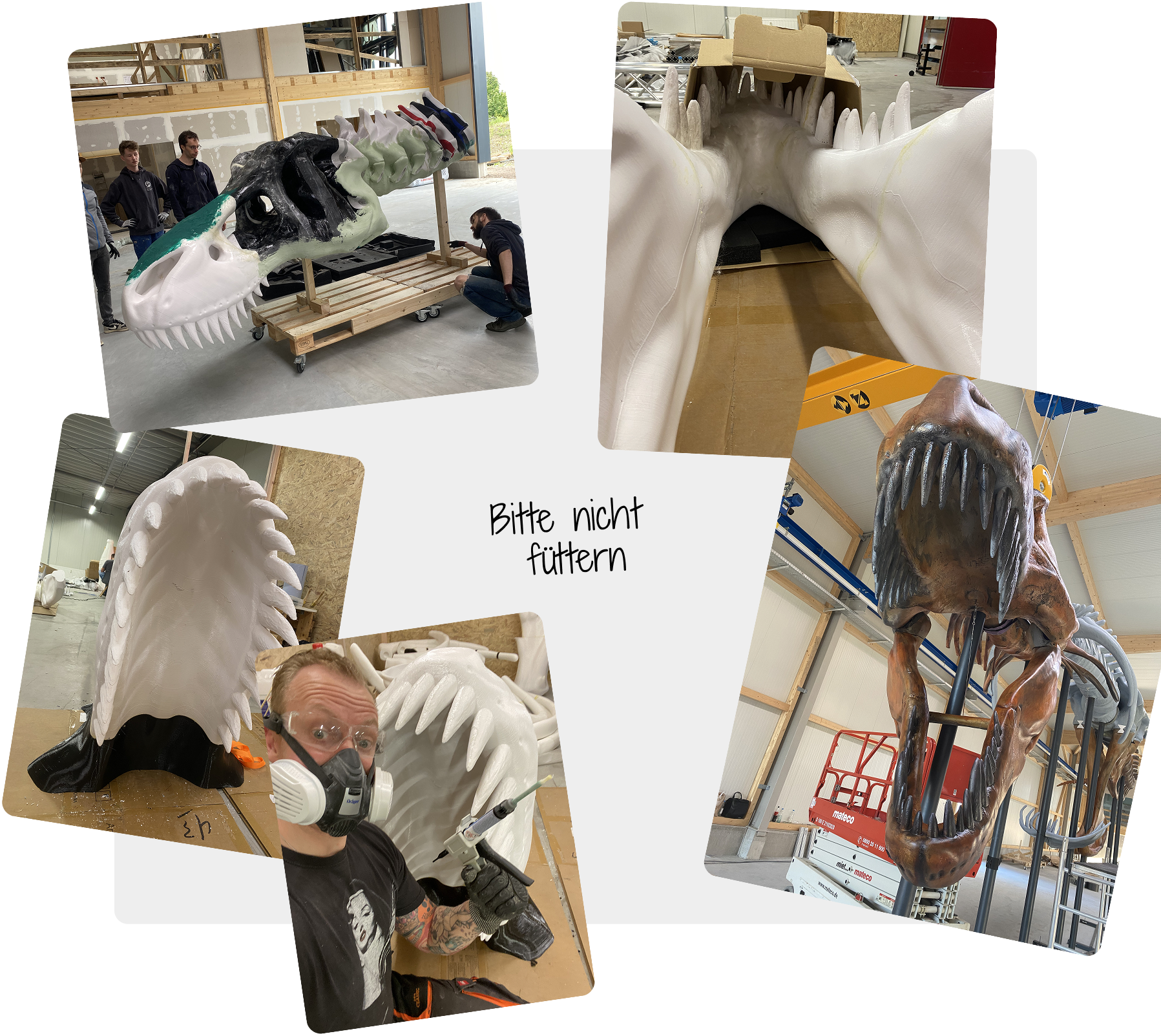
3D model creation
02
Large format 3D printing
03
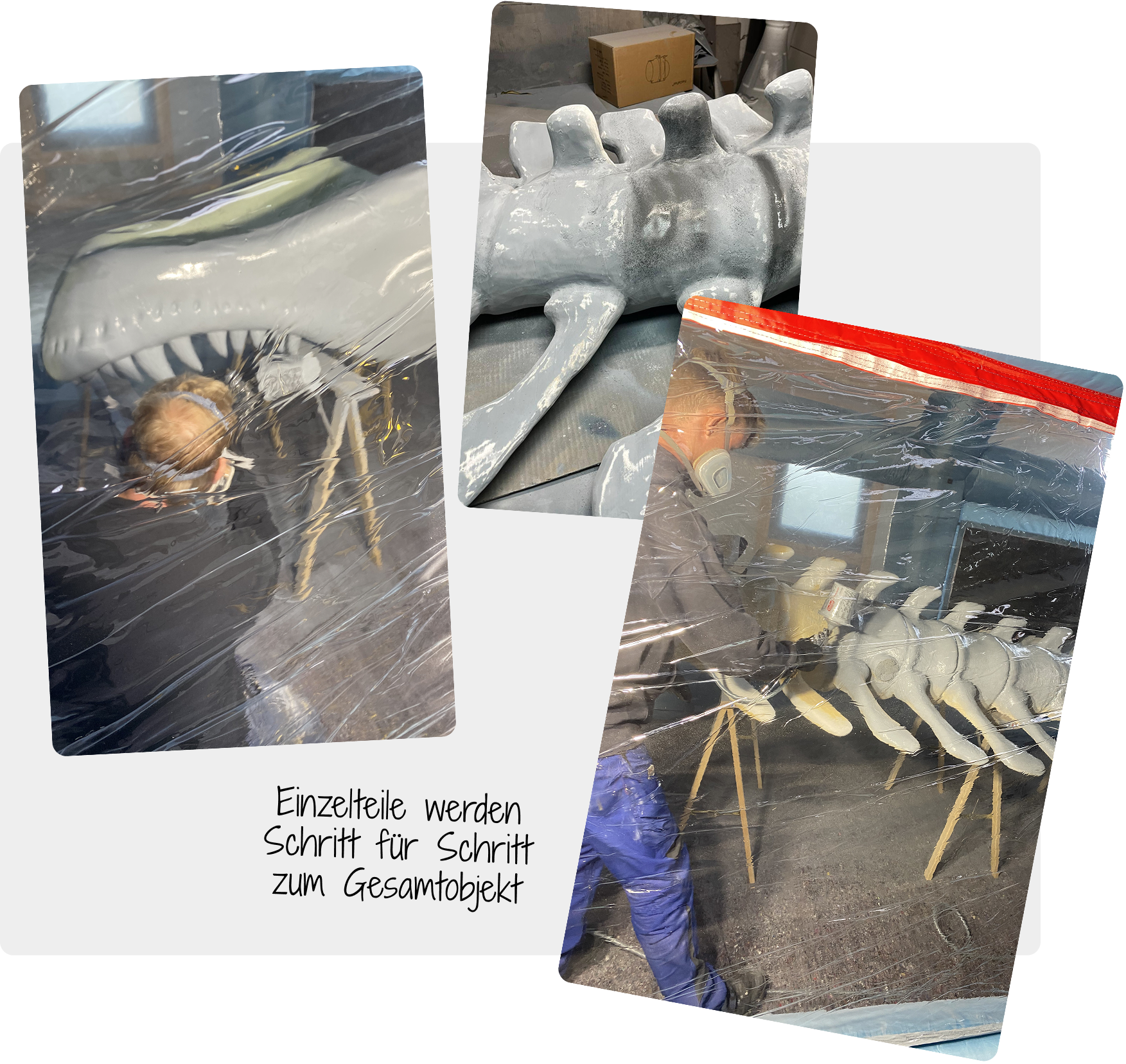
Assembly & painting
Project process
The first impression determines the brand impact
In event marketing, the first impression is critical. Visitors quickly decide whether an installation looks professional, interesting, or relevant. A strong object can draw people in, while a weak one can cause them to walk right past.
It is not just about size. A large object is not automatically a good one. What matters is the interplay of concept, form, surface, color, positioning, and craftsmanship.
A high-quality event installation can:
- make a brand appear larger,
- add emotional depth to a product,
- make a campaign theme easier to understand,
- encourage visitors to stop,
- spark conversations,
- create lasting memories,
- generate content for digital channels.
Conversely, a poorly executed installation can have the exact opposite effect. Visible seams, messy surfaces, incorrect colors, or unstable structures undermine the impact of the entire presentation.
This is why technical and manual execution is a core component of brand communication.
Large-format 3D printing as a tool for event marketing
Large-format 3D printing is particularly compelling in event marketing because it combines individuality, speed, and creative freedom.
Many event ideas originate from visual concepts: a key visual, a product, a character, a claim, packaging, a campaign world, or a digital rendering. 3D printing can translate these elements into real-world objects.
This is especially helpful for:
- product launches,
- pop-up stores,
- roadshows, Custom shapes instead of generic decor
- Event spaces are often filled with similar elements: displays, banners, trusses, screens, counters, roll-ups, and standard furniture. While these elements have their place, they rarely create a sense of surprise.
- Custom 3D objects can make exactly that difference.
- They create shapes that don't come from a catalog. They translate brand motifs into physical space. They make products larger, characters more tangible, and campaign ideas more visible.
- Possible objects include, for example:
- oversized products,
- walk-in or semi-walk-in installations,
- brand mascots,
- figures and characters,
- XXL-format product packaging,
- abstract brand symbols,
- photo spots,
- sculptures,
- Stage elements,
- Counter or room objects,
- decorative custom builds.
- This individuality is particularly valuable for short-term campaigns. The object does not need to exist permanently, but it must be unmistakable at the right moment.
- Trade fair appearances,
- brand activations,
- festivals,
- corporate events,
- POS campaigns,
- temporary exhibitions,
- brand spaces.
The advantage is that the object does not have to be assembled from standard modules. It can be developed to suit the campaign.
This results in installations that do not feel generic, but are conceived directly from the brand identity.
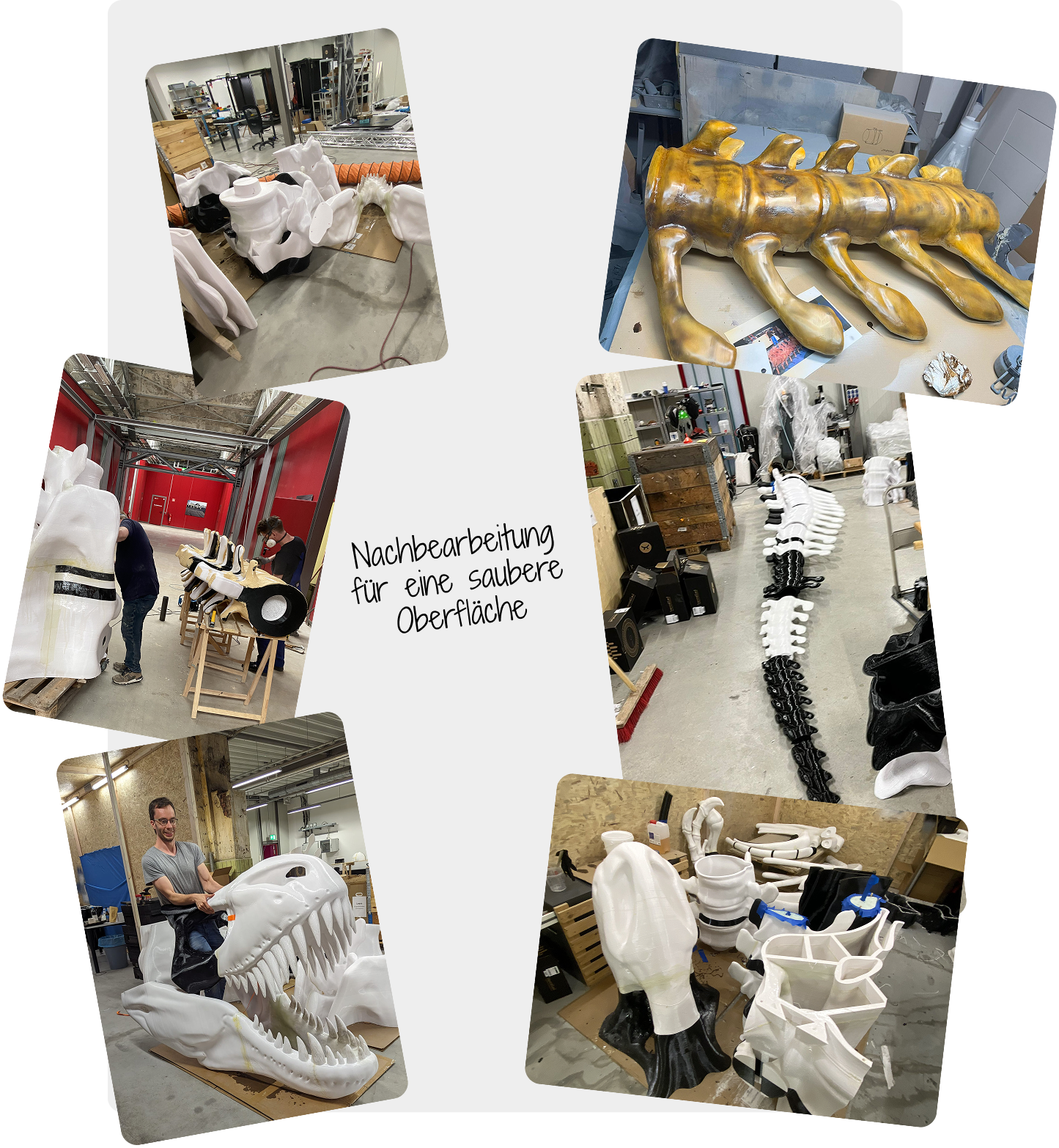
Photo spots: When event objects live on digitally
An event installation does not end at the venue. In many cases, its true reach only begins when visitors share photos or videos.
That is why temporary installations today must also be designed with cameras in mind.
A good object works from various perspectives. It has a clear silhouette, recognizable colors, clean surfaces, and a coherent relationship with the brand. It gives visitors a reason to stop and take a picture.
Large-format 3D printing is particularly well-suited for this because shapes, sizes, and surfaces can be individually tailored to this purpose.
A photo spot can:
- engage visitors,
- Generate social media reach,
- Improve press photos,
- Extend brand messaging,
- Strengthen event memories,
- Spread campaign content beyond the venue.
This is precisely why an object shouldn't be built just "for the moment." It also has to work in photos, because these images often remain visible longer than the event itself.

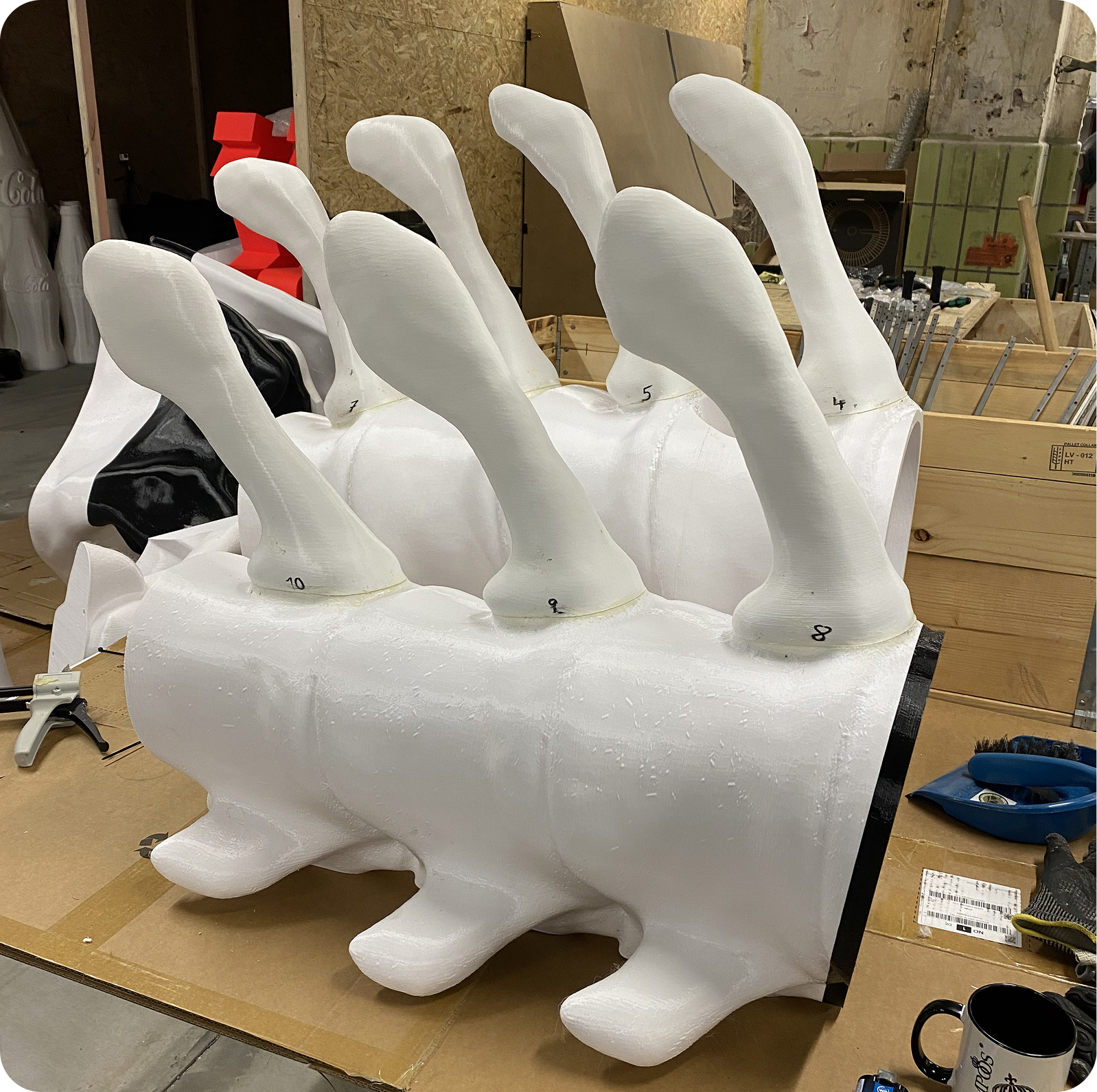
Quality becomes even more visible in photos
What might only be briefly noticed on-site can remain permanently visible in photos. An untidy seam, a wavy surface, a poorly painted spot, or an off-color shade quickly becomes a problem in pictures.
This is particularly critical for event installations because they are frequently photographed and filmed. Visitors post spontaneously, press photos are published, and companies use the material later for recaps, presentations, or social media.
That is why a high-quality finish is a central part of the planning process.
For 3D-printed event objects, this includes, depending on the project:
- clean joining of segments,
- sanding of transitions,
- filling of uneven areas,
- priming of the surface,
- painting in matching shades,
- airbrush work,
- special effect finishes,
- protective coatings,
- assembly of additional parts,
- Integration of lighting or technology.
The goal is not just to build an object. The goal is for it to make an impact in the space and in photos.
Stability and safety: Even temporary objects must be functional
Event objects are about more than just aesthetics. An installation must also be practical.
It needs to be transported, assembled, positioned, and potentially dismantled again. It may be placed near visitors. It will be touched, photographed, or walked around. It must stand securely at a trade fair booth, in a store, or at an event venue.
That is why stability, segmentation, and assembly planning are essential components of a professional project.
Key questions to clarify include:
- What are the size limitations for the object?
- What is the maximum weight for individual segments?
- How will it be transported?
- How will it be assembled?
- Is a base required?
- Are there attachment points?
- Is it intended for indoor or outdoor use?
- Does the object need to be reusable?
- How durable does the surface need to be?
- How close will visitors get to the object?
Large-format 3D printing offers the advantage that such questions can be addressed during the digital planning phase. The object can be segmented, reinforced, adjusted, and prepared for its specific application.
This results in an installation that not only looks good but is also practical to use.
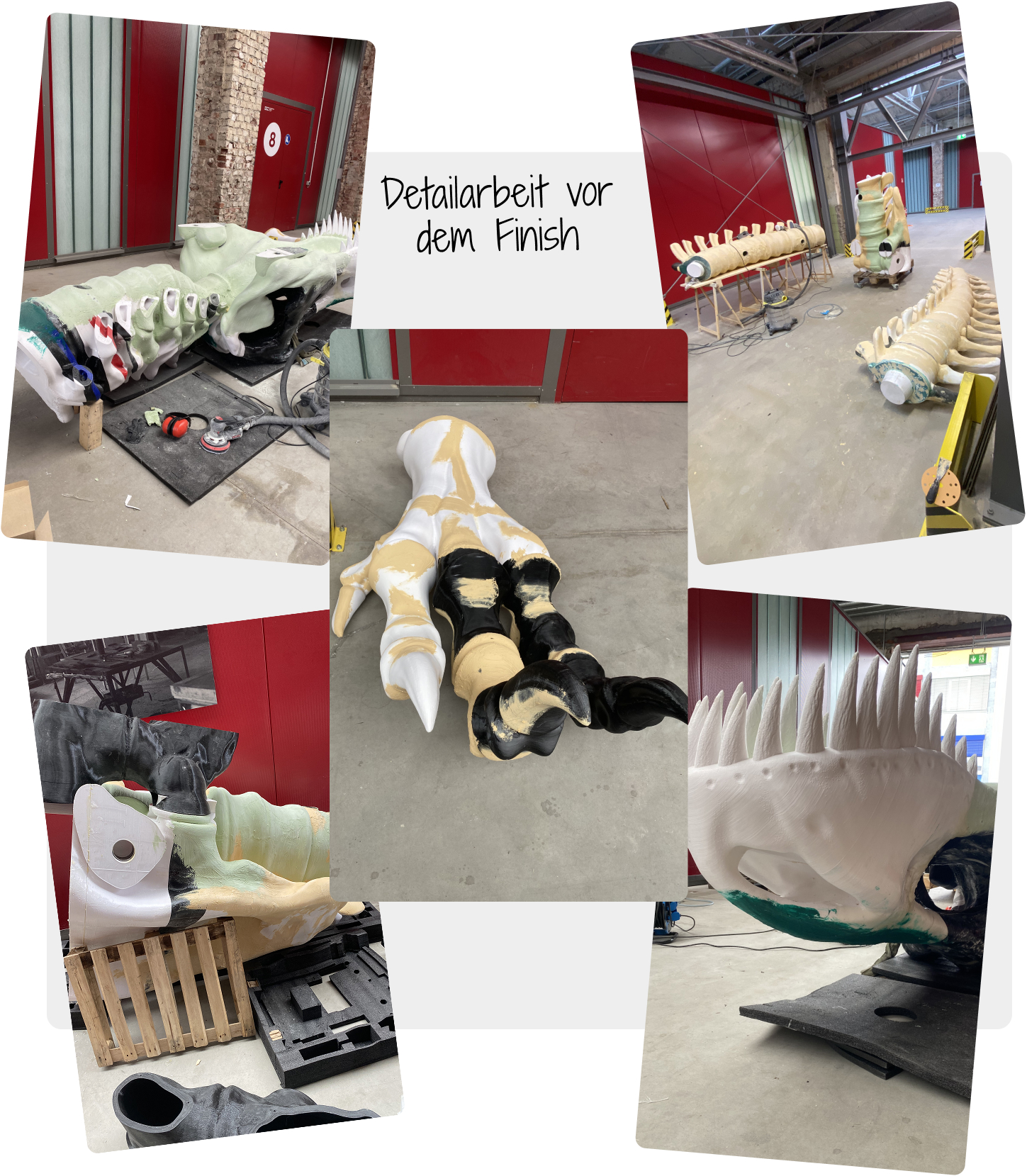
Short-term use, lasting impression
An event installation may only be in place for a few days. Its impact, however, can last much longer.
It appears in photos, videos, recaps, presentations, on company websites, in social media posts, and in the memories of visitors. Sometimes, a single object even becomes the central image of an entire campaign.
That is why it is worth viewing temporary objects as more than just disposable decor. They are an integral part of brand staging.
A high-quality event object can:
- visually define a campaign,
- strengthen brand perception,
- engage visitors,
- underscore the quality of an event,
- be reused after the event,
- appear in future campaigns,
- serve as a reference project.
In event marketing, the timeframe may be short, but the visual impact is long-lasting.
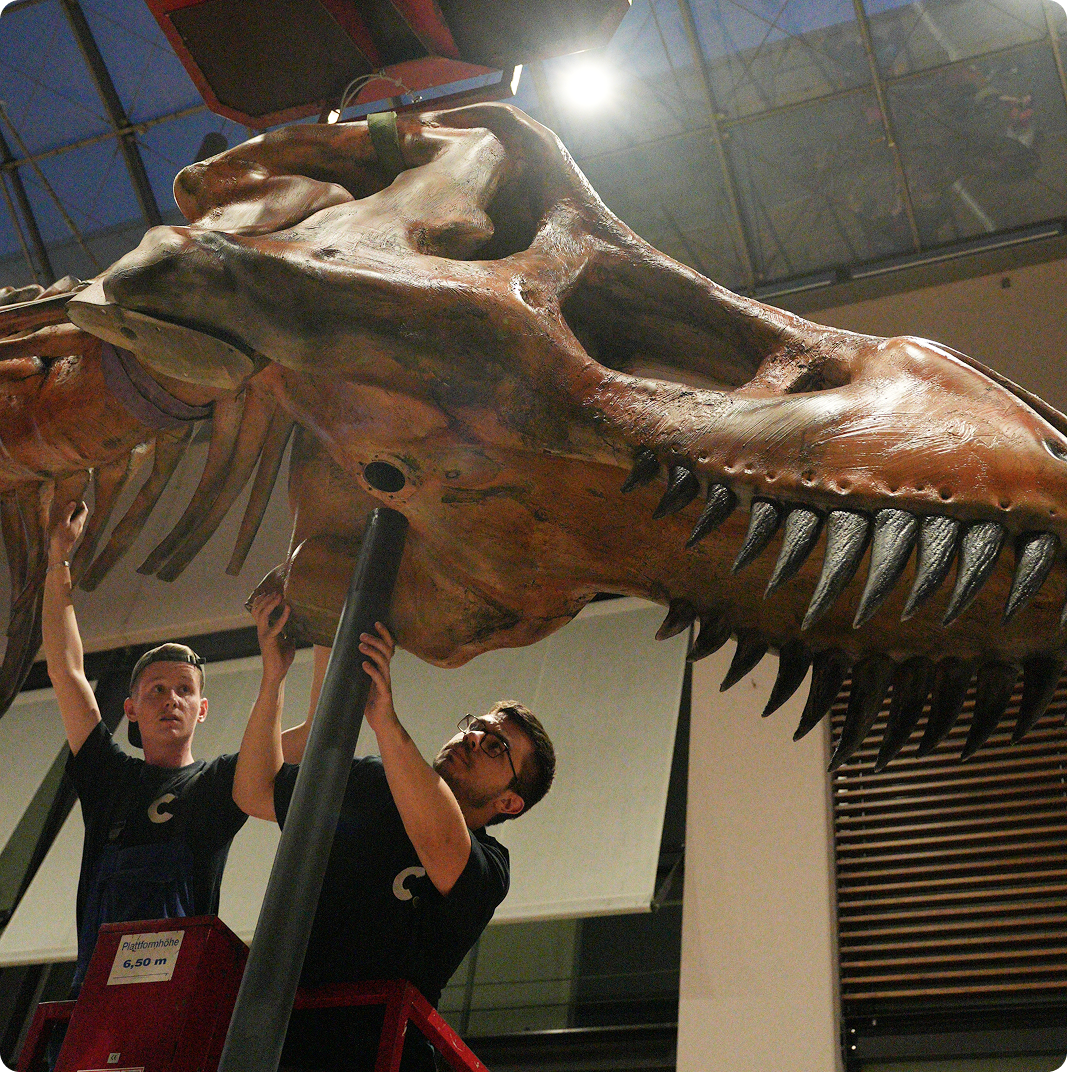
Case study: A life-sized T-Rex skeleton at Ruhr Park Bochum
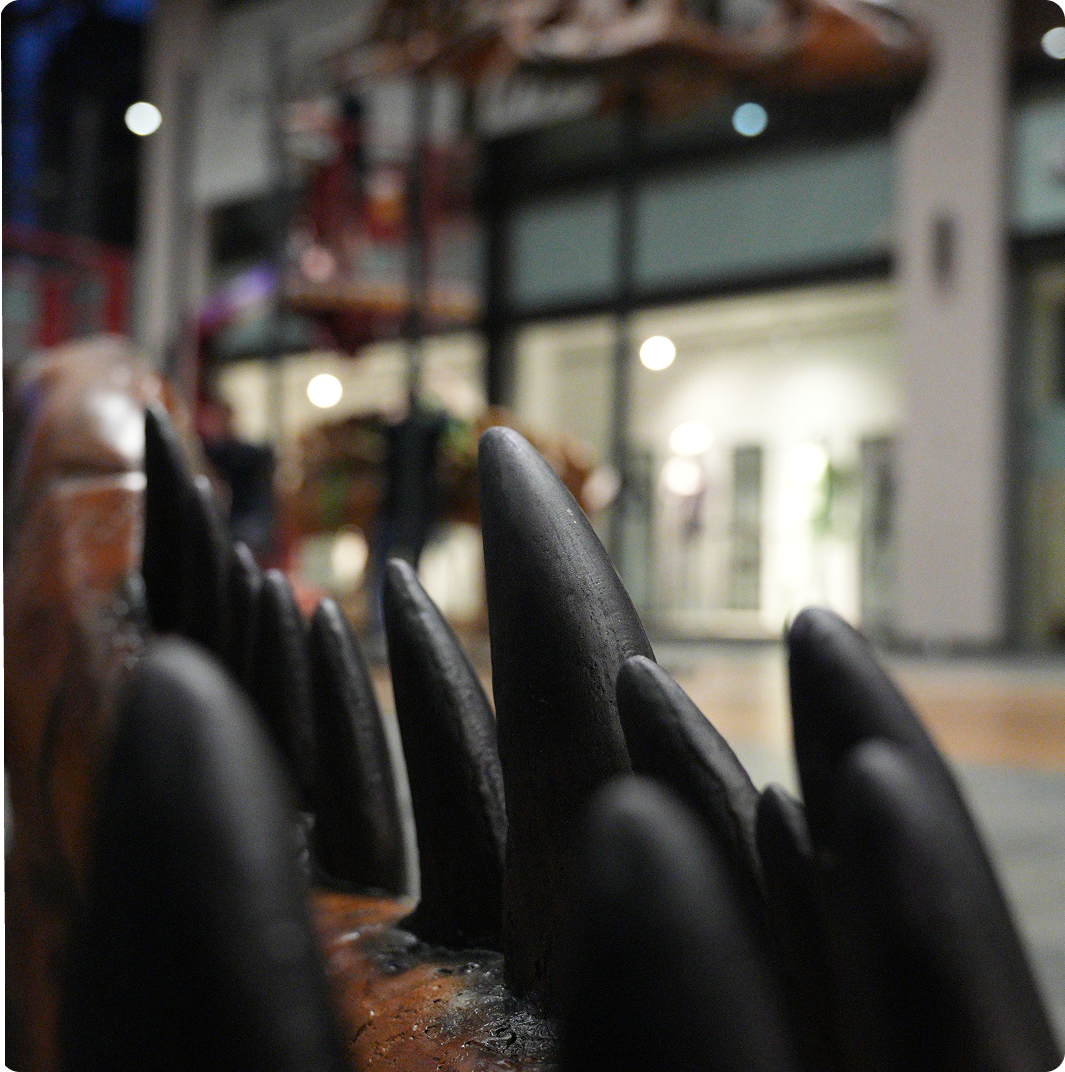
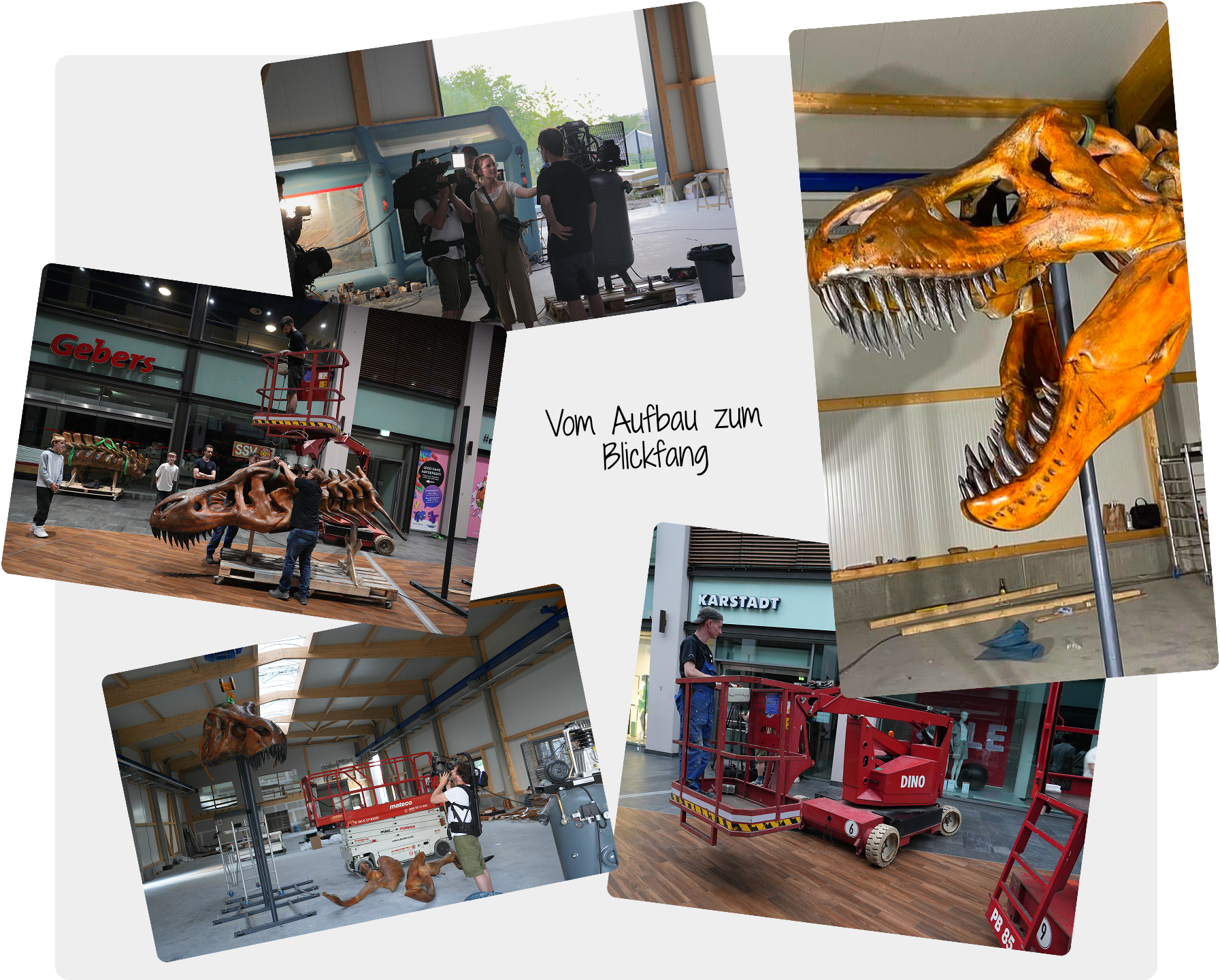
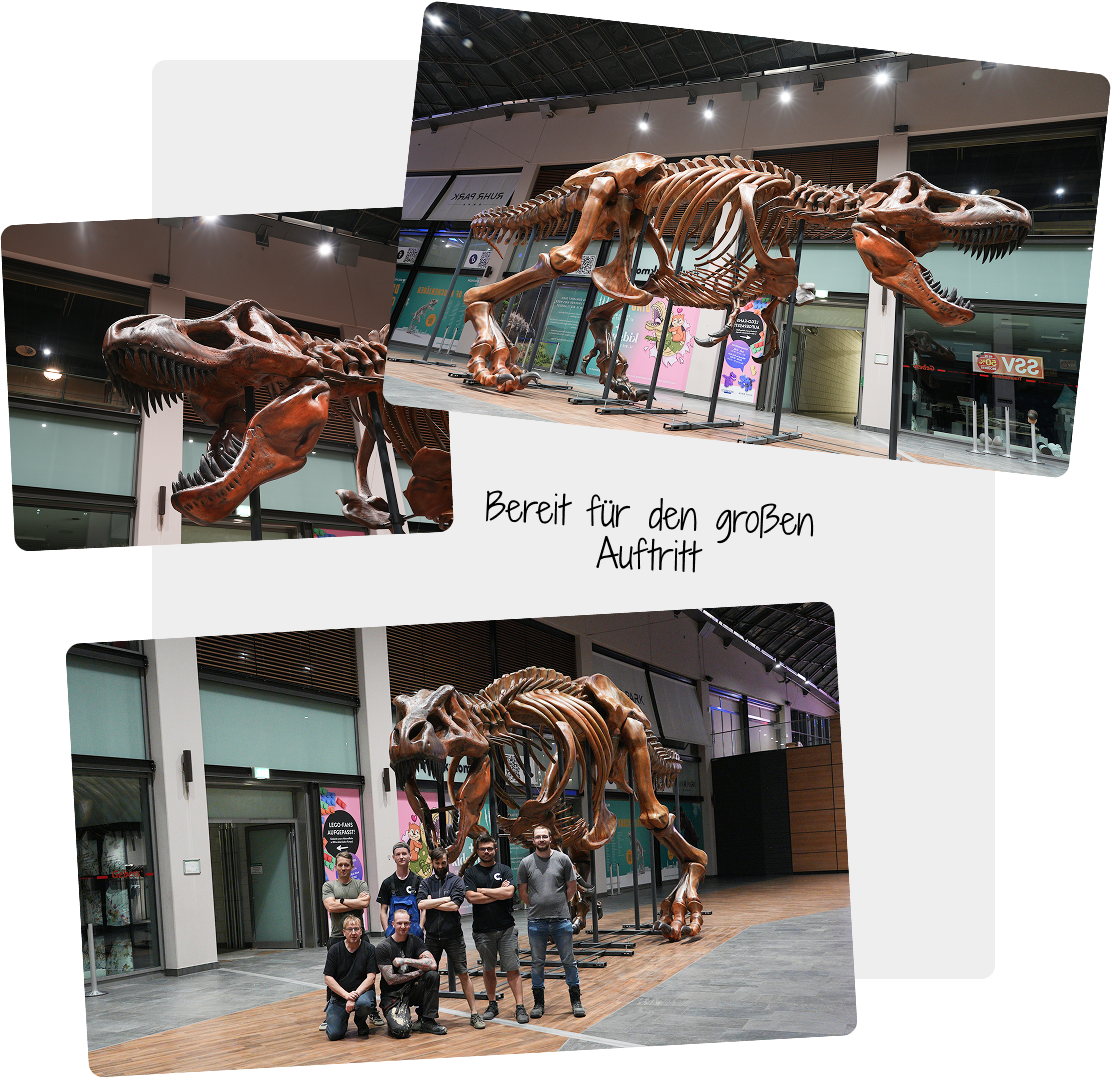
A particularly vivid example of this is our life-sized, 3D-printed T-Rex skeleton. In 2024, it was presented for several weeks at what was then Ruhr Park Bochum, now known as Westfield Ruhr Park.
With its imposing size, the T-Rex became an unmissable focal point of the area. Crowds stopped to marvel at the skeleton and captured the encounter in photos and videos. The installation delighted children and adults alike, demonstrating how powerfully an extraordinary 3D object can shape a public space.
Although the skeleton was only on-site for a limited time, its impact was anything but fleeting. It generated attention, conversation, and countless memories. That is precisely the strength of high-quality temporary installations: they do not need to remain in one place permanently to leave a lasting impression on many people.
The T-Rex skeleton also highlights the potential that large-format 3D printing offers for shopping centers, exhibitions, events, and high-traffic promotional areas. Even complex and monumental forms can be realized as impressive, spatial experiences.
Reusability and modular planning
Not every temporary installation has to disappear after its first use. Many objects can be planned so that they can be used multiple times, stored, transported, or adapted for future events.
Large-format 3D printing provides excellent conditions for this. Objects can be segmented, designed modularly, or tailored to specific transport requirements.
This is particularly useful for:
- roadshows,
- trade fair series,
- recurring brand events,
- pop-up concepts,
- POS campaigns,
- international events,
- multiple locations.
An object can be created for an initial campaign and later reused or adapted. This turns a temporary installation into a flexible brand asset.
It is important to consider this possibility early on. Reusability doesn't start after the event; it begins with construction, segmentation, surface finishing, and transport planning.
High-quality execution despite tight deadlines
Event projects are often under significant time pressure. Even so, the result must never look rushed.
Large-format 3D printing can help here because digital data can be quickly translated into physical components. If a model is available or can be created quickly, production can be planned efficiently. Changes can be made digitally before production, and complex shapes can be realized without the need for traditional tooling.
But speed alone is not enough. A fast-produced object is only valuable if it also looks high-quality in the end.
That is why the entire process is crucial:
from the idea to data verification,
from model adjustment to segmentation,
from printing to post-processing,
from painting to ready-to-assemble installation.
Experience is essential, especially with tight schedules. The better a project is prepared, the less friction there will be during production, finishing, and assembly.
Typical applications in event marketing
Product launches
A product launch requires a new product to be understood quickly and presented impressively. An oversized product display, a technical cutaway model, or a staged brand object can help generate attention and make unique features visible.
Large-format 3D printing is particularly suitable when a product needs to be scaled up from digital data or realized as an eye-catching exhibit.
Pop-up stores
Pop-up stores thrive on atmosphere, brand recognition, and photogenicity. They are designed to create a temporary brand space that stands out from ordinary retail areas.
Custom 3D objects can be used as room sculptures, product displays, photo spots, or decorative brand elements.
Roadshows
For roadshows, objects must not only look good but also be portable and robust. They are assembled, disassembled, and moved multiple times.
Through digital segmentation and thoughtful design, large-format 3D printed objects can be planned to be suitable for repeated use.
Brand activations
Brand activations need clear visual anchors. A physical object can make an abstract campaign idea tangible and invite visitors to interact.
This could be a character, a product, a symbol, a slogan object, or a free-form installation.
Trade fair and event spaces
At trade fairs and events, many impressions compete for attention simultaneously. A custom 3D object can help you stand out from the crowd and attract visitors effectively.
Especially when combined with lighting, color, paint finishes, or strategic positioning, an object becomes a real eye-catcher.
Social media installations
Some event objects are specifically designed to be photographed or filmed. They must work from multiple angles, align perfectly with the brand, and provide a visual reason for visitors to share them.
Large-format 3D printing enables exactly these kinds of custom shapes and staging.
What clients can prepare before starting a project
To provide an initial assessment of an event project, some information is particularly helpful. The clearer the purpose and framework conditions, the better we can plan a high-quality installation.
Helpful details include:
- Type of event,
- Desired object or motif,
- Existing renderings, sketches, or CAD data,
- Desired size,
- Location,
- Indoor or outdoor use,
- Planned timeframe,
- Desired duration of use,
- Transport requirements,
- Setup and dismantling times,
- Proximity to the audience,
- Desired surface finish,
- Corporate design guidelines,
- Potential for reuse,
- Desired photo opportunity or social media effect.
Even if an idea is not yet fully developed, an early technical assessment can be helpful. Often, it is possible to identify during the concept phase how an object can be made more stable, lighter, easier to transport, or more impactful.
Why the combination of 3D printing and finishing is crucial
In event marketing, it is not enough to simply manufacture an object. It must be staged effectively. It must fit the campaign. It must work under lighting. It must look impressive in photos. It must look good up close.
Conclusion: Temporary installations must make an immediate impact
Event marketing is a race against time. An object shouldn't just work eventually; it needs to work instantly. It must attract visitors, look great in photos, align with the brand, and function perfectly within the space.
That is why temporary installations should not be viewed as mere decoration. They are an integral part of the campaign, the brand experience, and often one of the most visible touchpoints with your audience.
Large-format 3D printing offers the ideal solution for this. It makes custom shapes a reality, translates digital campaign concepts into physical objects, and enables eye-catching installations for events, trade shows, pop-up stores, product launches, and brand activations.
At Creative Polymer, we combine large-format 3D printing with technical planning, segmentation, finishing, and painting. The result is temporary installations that look premium, are safe to use, and stand out exactly where attention is needed.
Because even if an event only lasts a short time, the impression lasts forever.
3D printing provides the form.
Finishing creates the surface.
Painting delivers the brand impact.
Technical planning makes the object functional.
Assembly preparation ensures it works on-site.
It is this synergy that creates a temporary installation that doesn't look temporary, but high-quality.
That is precisely the difference between simple event decor and a true brand object.
What our customers say
Request a project
Let's

together
If you would like to have your own custom XXL object, trade fair exhibit, or promotional item created using 3D printing, we can print it for you professionally.
Creative Polymer
Am Hellweg 5
44805 Bochum



Copyright © Creative Polymer
Realized by famesites
Realized by famesites

