
Technology
3D-printed exhibition exhibits for Flender: How a multi-tone transmission became a portable exhibit

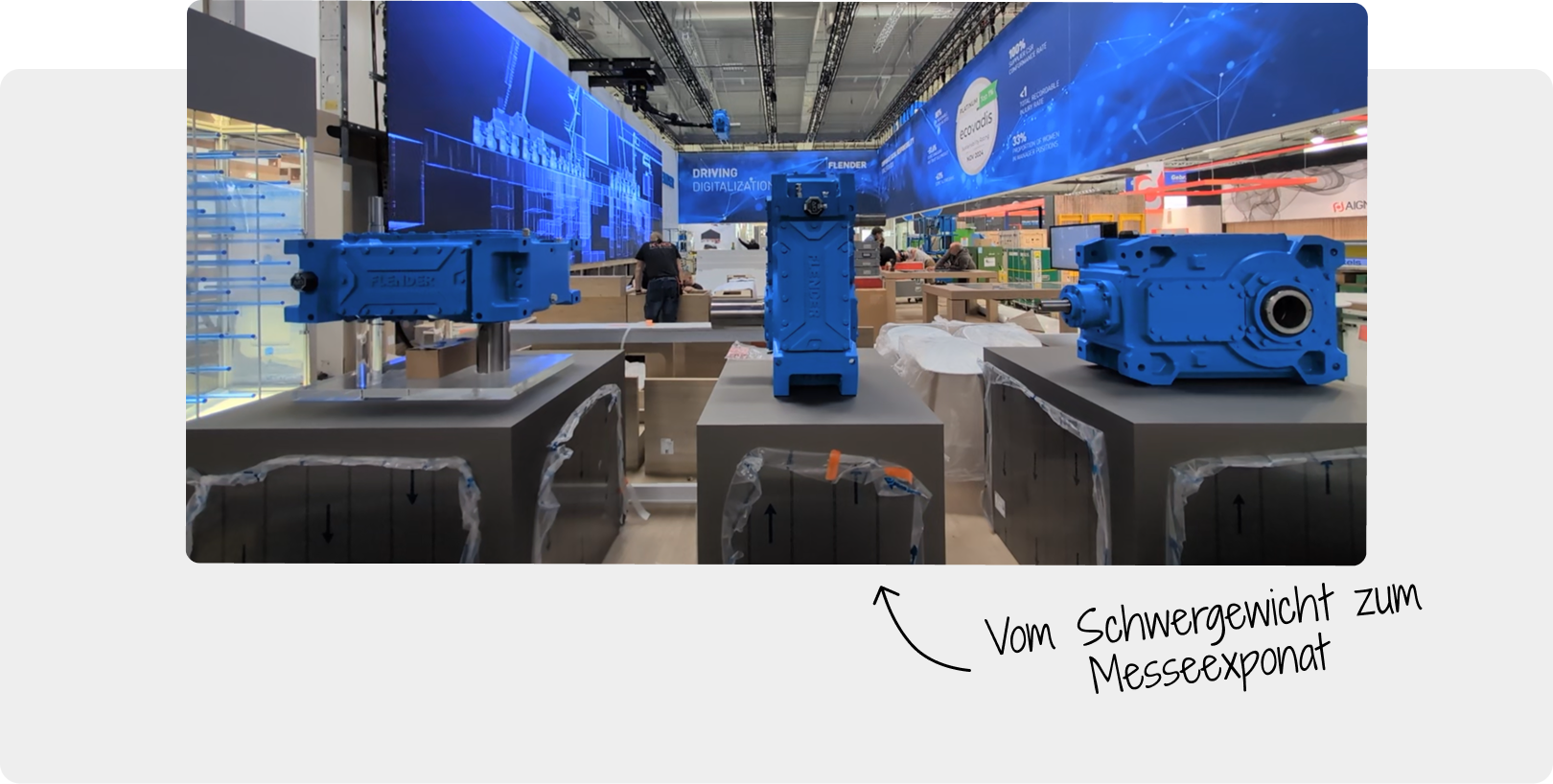
A transmission is heavy. It's not exactly easy to place an object weighing tons at the exhibition stand. Our exhibition exhibit, which weighs just under 50 kg, is significantly easier to transport than the original transmission, which weighs around 1000 kg.
That was precisely the challenge of this project
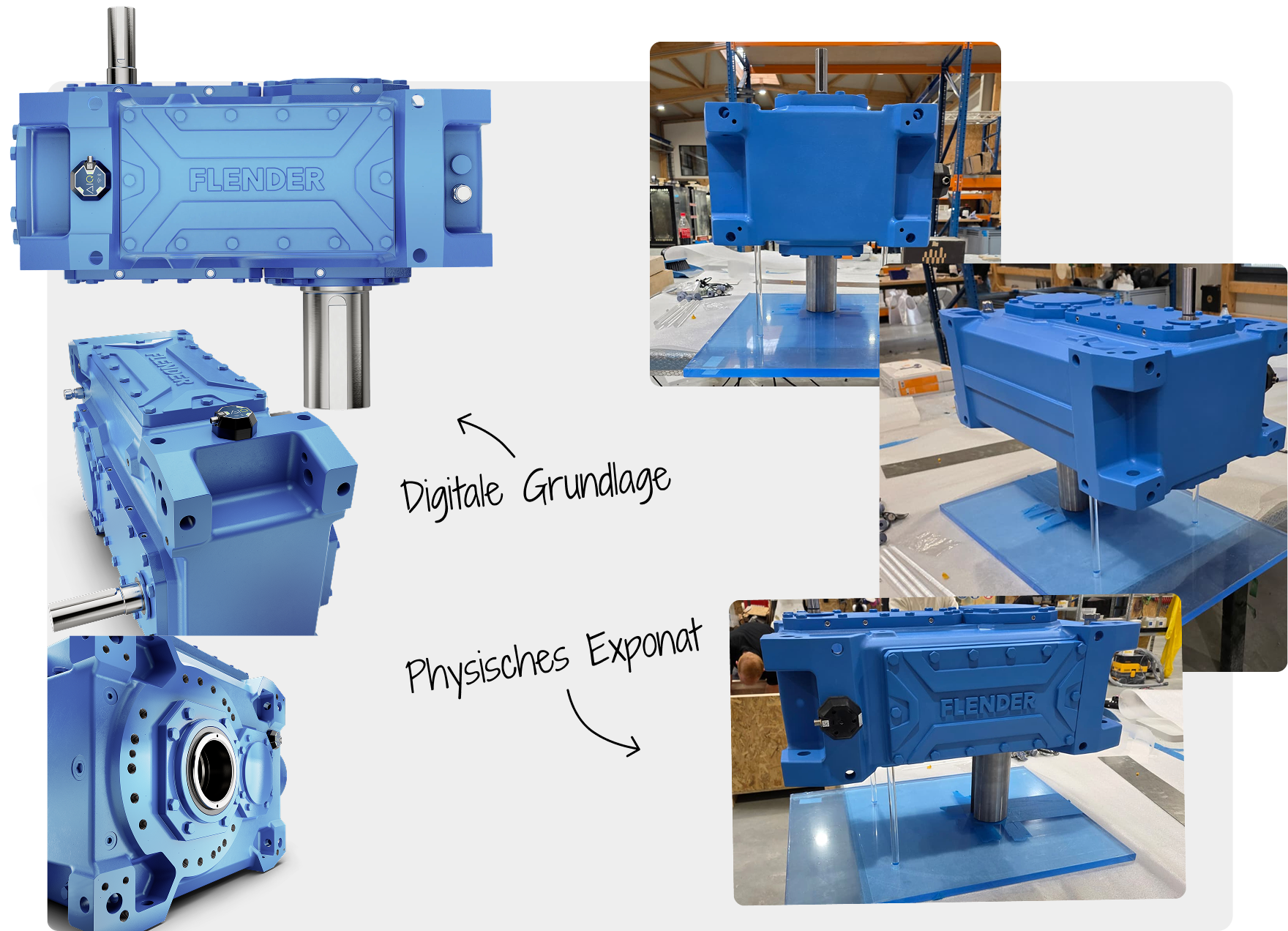
For Flender, we were able to implement two of their transmissions as detailed 3D-printed exhibition exhibits for indoor use. The original weighs around a ton. The aim was therefore to transform a technical heavyweight into an exhibit that could be safely transported, presented in a high-quality manner and used in practice at trade fairs.
A transmission is usually not something that you simply pick up. It is too difficult, too complex, often too valuable and in the original barely enough to be presented spontaneously at an exhibition stand. In other words, anyone who has ever tried to move a real transmission knows that the focus quickly becomes more on the back than on the product.
So we've done exactly what we specialize in: making difficult easy — in the truest sense of the word.
When the original is too big and too heavy for exhibition construction
Large industrial components impress. They stand for precision, performance and technical expertise. In Exhibition Construction and in Product Presentation, however, they usually also pose significant challenges: high transport costs, complex logistics, difficult handling and high safety and construction requirements.
Especially with a transmission with an original weight of around one ton, it quickly becomes clear that the original is not the most practical solution for trade fairs, showrooms or presentations. What is needed is a trade fair exhibit that preserves the technical effect and attention to detail of the original, but is significantly lighter, more manageable and more flexible to use.
This is exactly where you can see what large-format 3D printing from the heart of the Ruhr region can do.
Our services
01
3D model creation
02
Large format 3D printing
03
Assembly & painting
Project process
Two detailed gears as 3D-printed trade fair exhibits
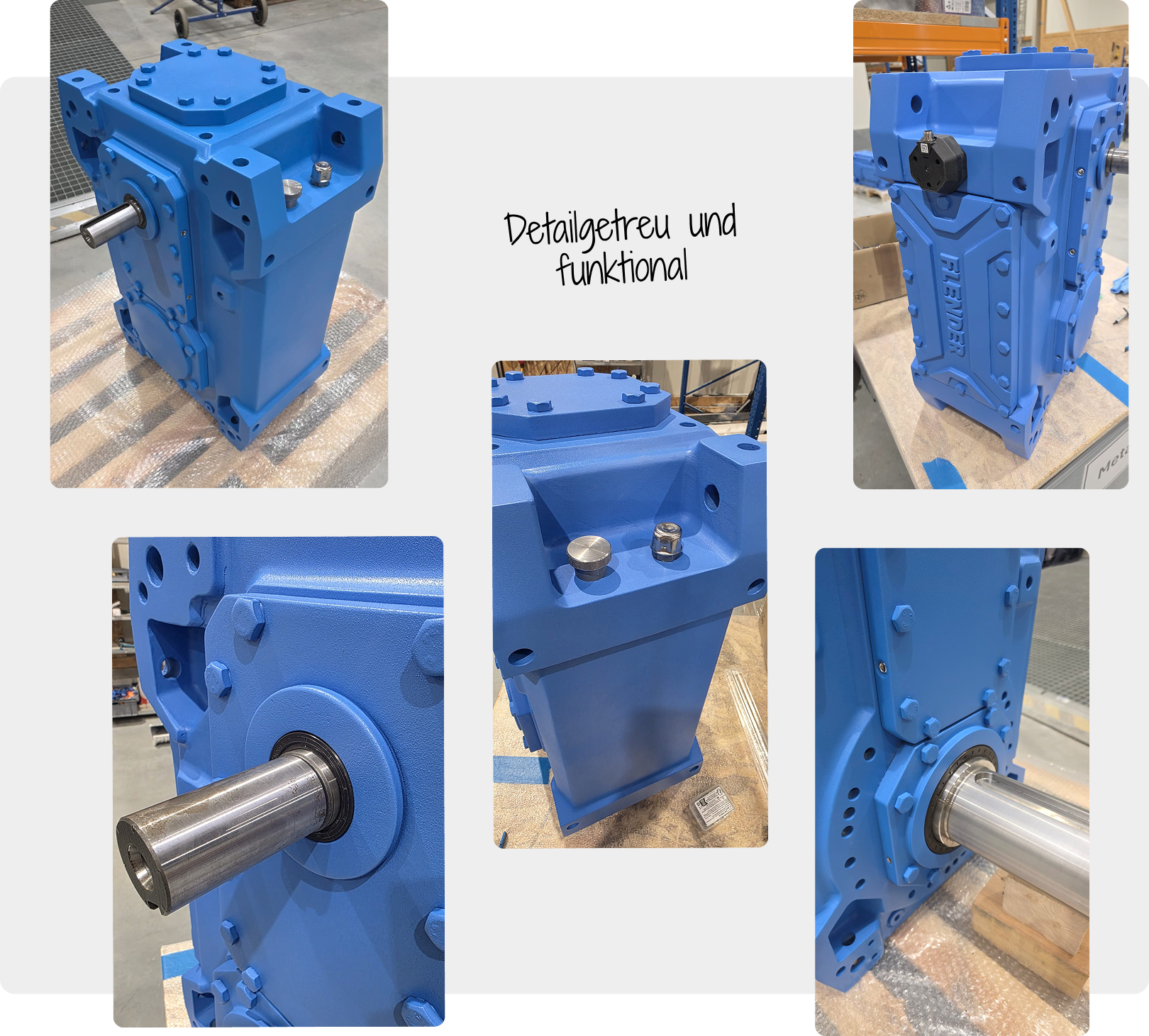
For Flender, we manufactured two gearboxes as large format 3D printing exhibits for indoor use. This was not about simplified showpieces, but about exhibition models that were as true to the original as possible with a high level of recognition and technical significance. Each wheel, every shaft and every contour is based on the original, but in a form that can be moved without a lift and without heavy-duty logistics.
In the End, the Finished Transmission Exhibit Had Dimensions of 655mm x 460mm x 255 mm. The result was a compact yet impressive 3D-printed exhibition that convincingly conveys the design language and technical features of the original.

Combination of materials for stability, authenticity and lower weight
To ensure that a 3D-printed transmission exhibit not only looks good but also looks sturdy and of high quality when used at a trade fair, it is important to choose the right material. In this project, different materials were specifically combined in order to combine authenticity, stability and a reduced overall weight in a meaningful way.
Among other things, an acrylic glass panel was installed with 9.8 kg, a large steel shaft with 21.2 kg, a small steel shaft with a diameter of 40 mm and 1.0 kg As well as that 3D-printed 16.3 kg gearboxes.
It is precisely this combination that shows what is important when it comes to high-quality 3D printing trade fair exhibits: stability and realism at key points, combined with a significantly lighter overall structure than the original. This turned an industrial product weighing tons into a portable exhibition exhibit that can be easily carried by two people.
Post-processing and painting for a high-quality finish
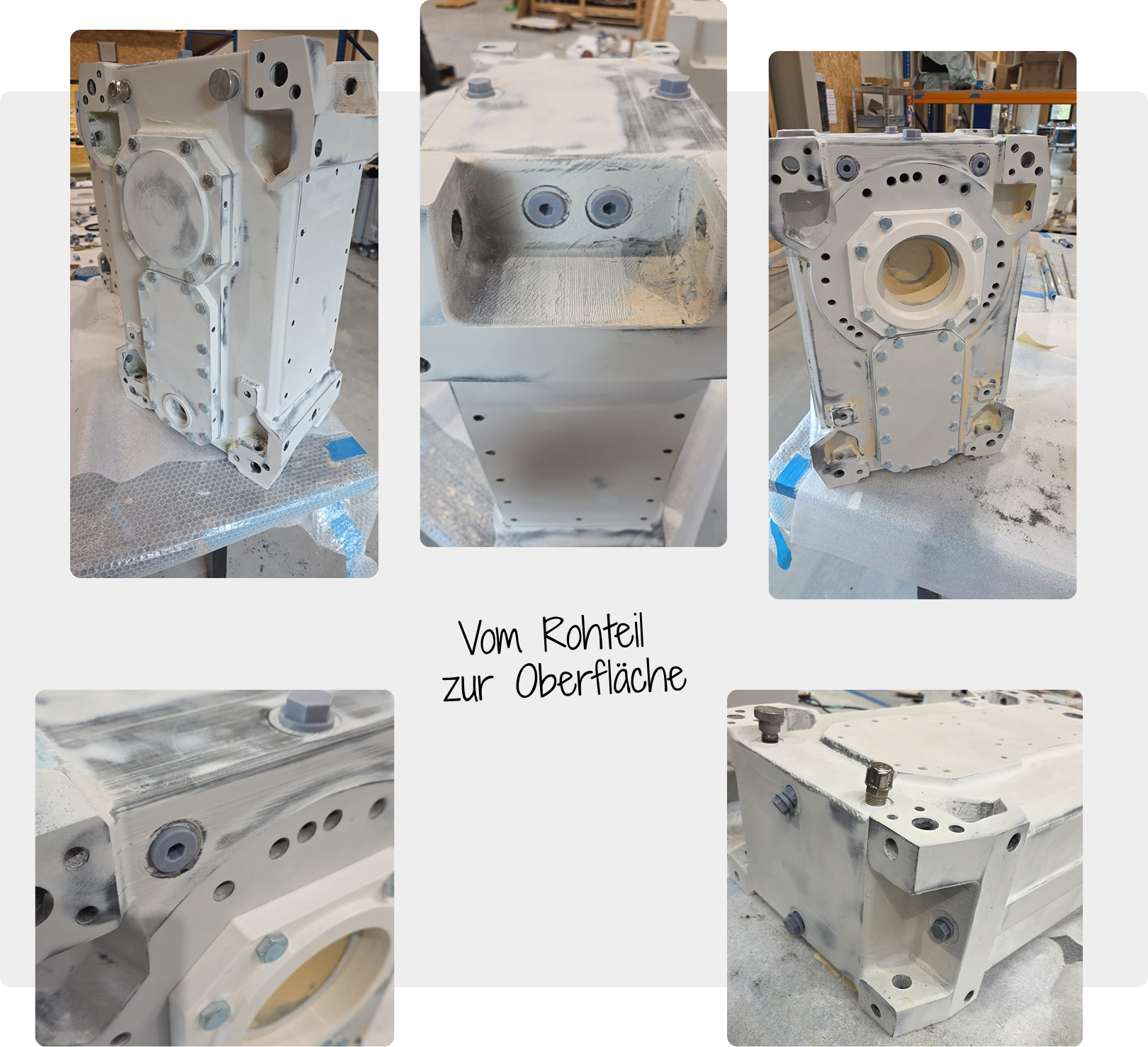
A convincing 3D-printed exhibition exhibit is not created by printing alone. Surface finishing is also crucial for a high-quality look and a professional effect on the exhibition stand.
For this reason, the exhibits were then carefully reworked. This included sanding, puttying and priming to create an optimal base for subsequent painting. This was followed by a high-quality, detailed painting according to customer specifications, tailored to interior use.
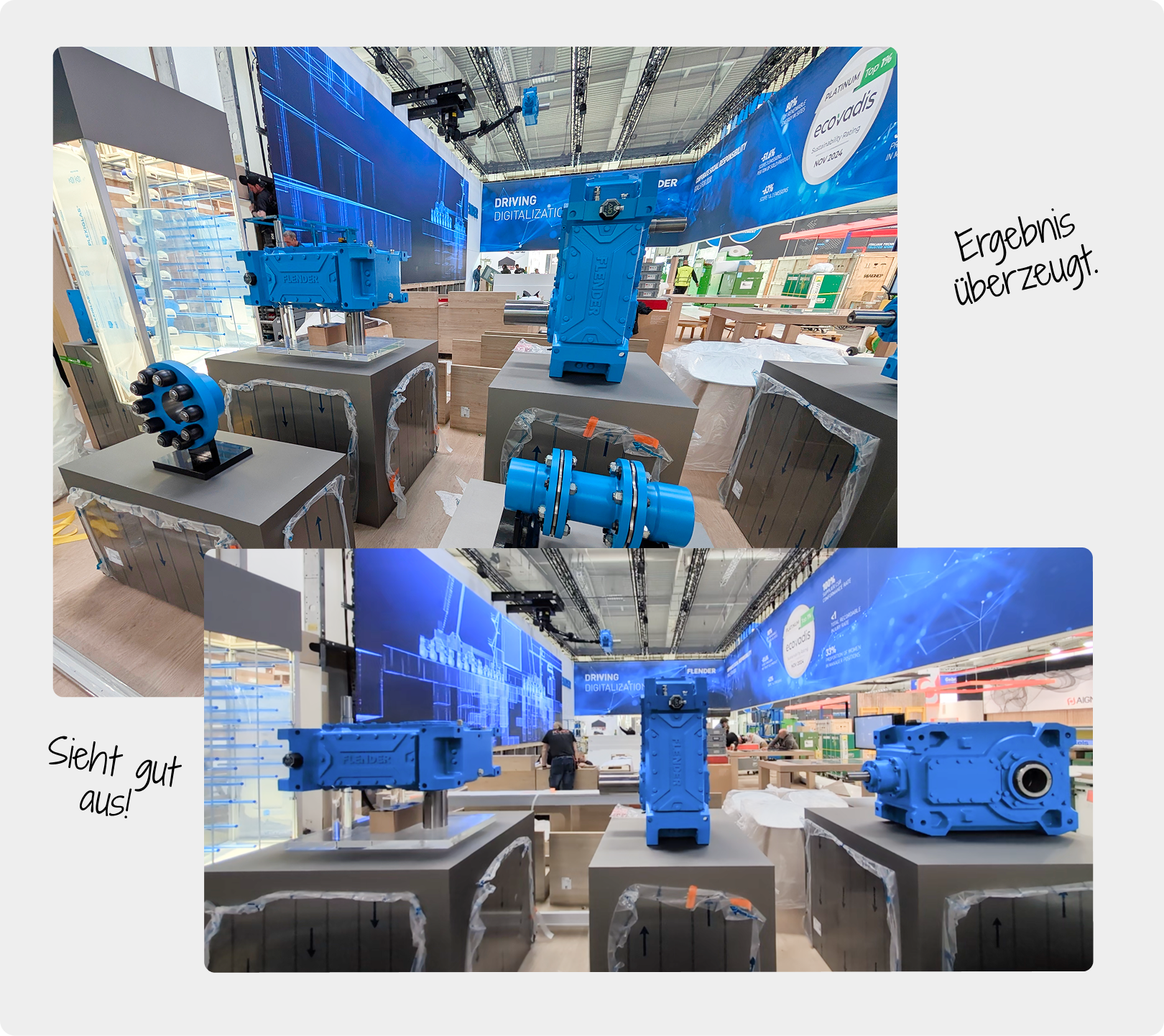
The result was 3D-printed transmission exhibits that are not only technically convincing, but also visually meet the high requirements in exhibition construction, in showrooms and in professional product presentation.
Secure Presentation at the Exhibition Stand
A professional exhibition exhibit not only includes the component itself, but also a safe and clean presentation. That is why we have also made a pedestal or bracket made of acrylic glass. This ensures that the exhibit is securely positioned at the exhibition stand and at the same time supports the high-quality overall effect.
This is an important aspect, particularly in the exhibition environment: An exhibit must not only be impressive, but must also be stable, easily accessible and neatly presented.
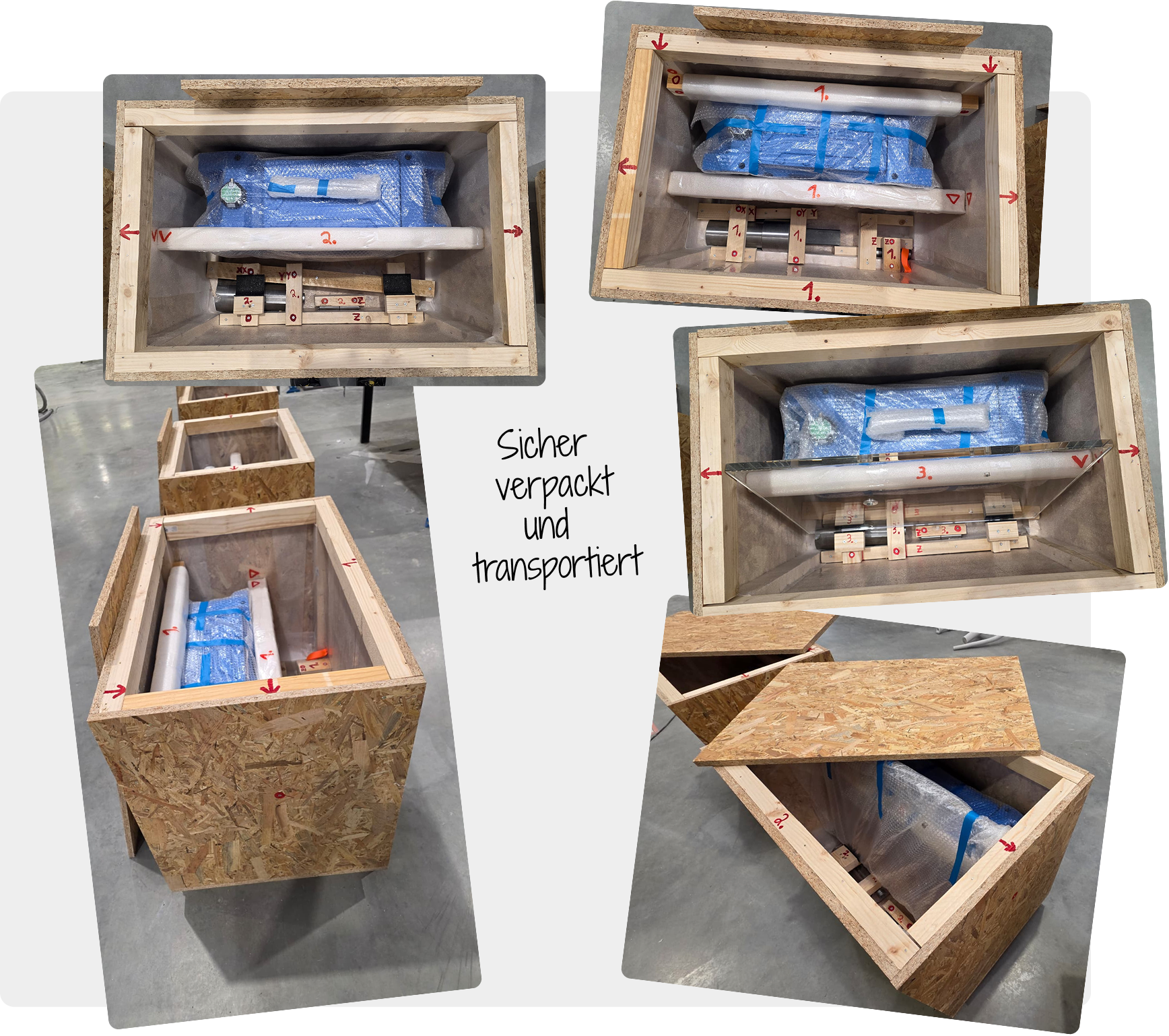
Transport Box for Safe Shipping and Storage
To ensure that the 3D-printed exhibition exhibits are optimally protected even during shipping and storage, a transport box was also made from approximately 18 mm thick OSB plates. It is used for safe transport and protected storage between operations.
Especially when it comes to high-quality 3D-printed exhibits, this is an important part of the overall concept. Because quality can only be maintained in the long term if transport and storage are also taken into account.
3D-printed exhibition exhibits as a practical solution for industry and sales
This project shows very clearly what added value large format 3D printing can offer for exhibition stand construction and industrial product presentation. When original components are too heavy, too cumbersome or too valuable for mobile use, 3D-printed trade fair exhibits create a convincing alternative.
They make complex technology visible, understandable and tangible. They facilitate discussions in sales, attract attention at the exhibition stand and make it possible to present products realistically without having to accept the logistical disadvantages of the original.
Detailed 3D printing exhibits are therefore a particularly effective solution, particularly in the areas of industry, mechanical engineering and technical product presentation.
A leader in 3D-printed trade fair exhibits — even when it gets time-critical
Such projects are not unique, but part of our daily work. Our company is one of the leading manufacturers of high-quality trade fair exhibits. We combine technical understanding, experience in large format 3D printing, with a machine park of over 30 large format 3D printers with an installation space of over 1000 x 1000 x 1300 mm, and high-quality surface processing with a clear view of the requirements of exhibition construction, marketing and product presentation, which we implement in our in-house paint shop according to the highest quality standards.
And even when projects become time-critical, we see them not only as a challenge, but above all as an incentive. Challenging time windows in particular require clean processes, flexibility and a high level of reliability. For us, this is exactly an essential part of professional project work.
What our customers say

Creative Polymer
Am Hellweg 5
44805 Bochum



Copyright © Creative Polymer
Realized by famesites
Realized by famesites

